
Best Examination Management System for Universities in India
What a university examination management system should cover, from question banks to results, with a fair comparison of options, a demo checklist and advice for the VC and IT head.
It is 11 pm, two days before the result date. The exam cell has marks in one spreadsheet, moderation changes in another and a list of re-evaluation requests sitting in someone’s inbox. One examiner’s totals do not match the award list, and the only person who understands the macro that compiles the final results is on leave. Most Controllers of Examinations have lived through some version of this night, and most have promised themselves it will be the last.
An examination management system is meant to make that promise real. The trouble is that the term now covers very different products, from simple timetable and hall-ticket tools to complete evaluation and result platforms. This guide explains what an examination management system should cover for an Indian university, where exam cells actually lose time, how the main types of exam management software compare, and which questions to ask before you sign. If you want to see how evaluation, moderation and results can run in one auditable workflow, explore the iCloudEMS Digital Evaluation solution as you read.
Why examination management has become a leadership issue
The scale of Indian higher education turns every exam cycle into a major operation. According to the Ministry of Education’s All India Survey on Higher Education (AISHE) 2023-24, India has 1,289 universities and university-level institutions and 48,246 registered colleges, with total enrolment of nearly 4.5 crore students. Each semester, universities must set papers, conduct exams, evaluate answer sheets, handle re-evaluation requests and publish results on a fixed calendar, often for affiliated colleges as well as their own campuses.
Expectations around transparency have also risen. Students and parents expect quick, clear answers when they challenge a mark, and accreditation bodies expect examination data to show learning outcomes, not just pass percentages. NAAC’s website lists 511 universities as accredited (status as on 12 December 2025), and its 2024 reforms toward Binary Accreditation and Maturity-Based Graded Levels continue the shift toward evidence-based assessment. In this environment, a delayed result or a disputed mark is no longer just an exam cell problem. It reaches the Vice Chancellor’s office, and sometimes the press.
What an examination management system should cover
The most useful way to judge any university examination management system is to map it against the full exam cycle rather than the single step that hurts most today. Universities often buy software to fix one painful stage and then discover that the pain has simply moved to the next one.
Before the exam, the system should support question papers and question banks, ideally with every question tagged to a course outcome and a Bloom’s Taxonomy level so that papers are balanced and outcome data is captured from the start. During evaluation, it should handle answer sheet scanning, anonymous allocation to examiners, on-screen marking and moderation. After evaluation, it should manage re-evaluation and challenge requests, compile marks automatically and publish results. Finally, after results are out, examination data should flow into NAAC, NBA and outcome-based education reporting without anyone rebuilding it from spreadsheets months later.
Of these stages, evaluation and result processing usually cause the most delays and disputes. They involve the most people, the most paper and the most hand-offs between offices. That is why many universities now treat digital evaluation as the core of their exam management software rather than an optional add-on.
Where exam cells lose time today
Before comparing products, it helps to list exactly where your own exam cell loses time. In most universities, the answers are remarkably similar. Answer books travel between the strong room, examiners and moderators, and every movement creates a risk of delay or loss. Examiners add totals by hand, and exam cell staff then re-type those totals into a results sheet, which means every mark is handled several times before a student sees it.
Re-evaluation requests are tracked in registers or email, often without a clear record of the original marking, so answering a single challenge can take days. Status updates depend on phone calls, because nobody can see how many scripts are still waiting for evaluation or moderation. And when the accreditation cycle arrives, IQAC teams spend weeks reconstructing examination data that already existed but was never captured in a usable form. A good examination management system should remove most of these problems at once, not just one of them.
The main types of options, compared fairly
Universities in India generally choose between four broad approaches to examination management. Each has a place, and the right one depends on exam volume, internal capacity and how much of the cycle you want under direct control.
| Option | What it covers | Where it works well | What to watch |
|---|---|---|---|
| Spreadsheets and paper | Manual scheduling, physical evaluation and Excel-based results | Small colleges with low exam volumes | Dependence on a few people, totalling errors and a weak audit trail |
| Standalone scheduling or registration tools | Timetables, registrations, hall tickets and seating | Institutions whose main pain is pre-exam logistics | Evaluation and results may still be manual or held in another system |
| Outsourced exam or evaluation agencies | A vendor runs parts of the cycle on your behalf | Institutions without internal scanning or evaluation capacity | Less direct visibility; confirm data ownership, access and audit trail |
| Exam and evaluation inside a connected university platform | Question banks, digital evaluation, moderation, results and accreditation data together | Universities that want one record from question paper to result | Needs joint planning by the exam cell, IQAC and IT |
The more of the exam cycle a single system holds, the fewer places there are for a mark to be lost or changed between stages. That single principle is often more useful than any feature comparison.
How to judge the evaluation and results stages
Because evaluation is the most time-critical part of the cycle, it deserves the most weight when you score competing systems. Start with anonymity and traceability. Barcode-based allocation should hide the student’s identity from examiners completely, and the system should keep a time-stamped record of who marked each question, when, and whether a moderator later changed it. Without that record, defending a mark during a re-evaluation request, an RTI application or a legal challenge becomes guesswork.
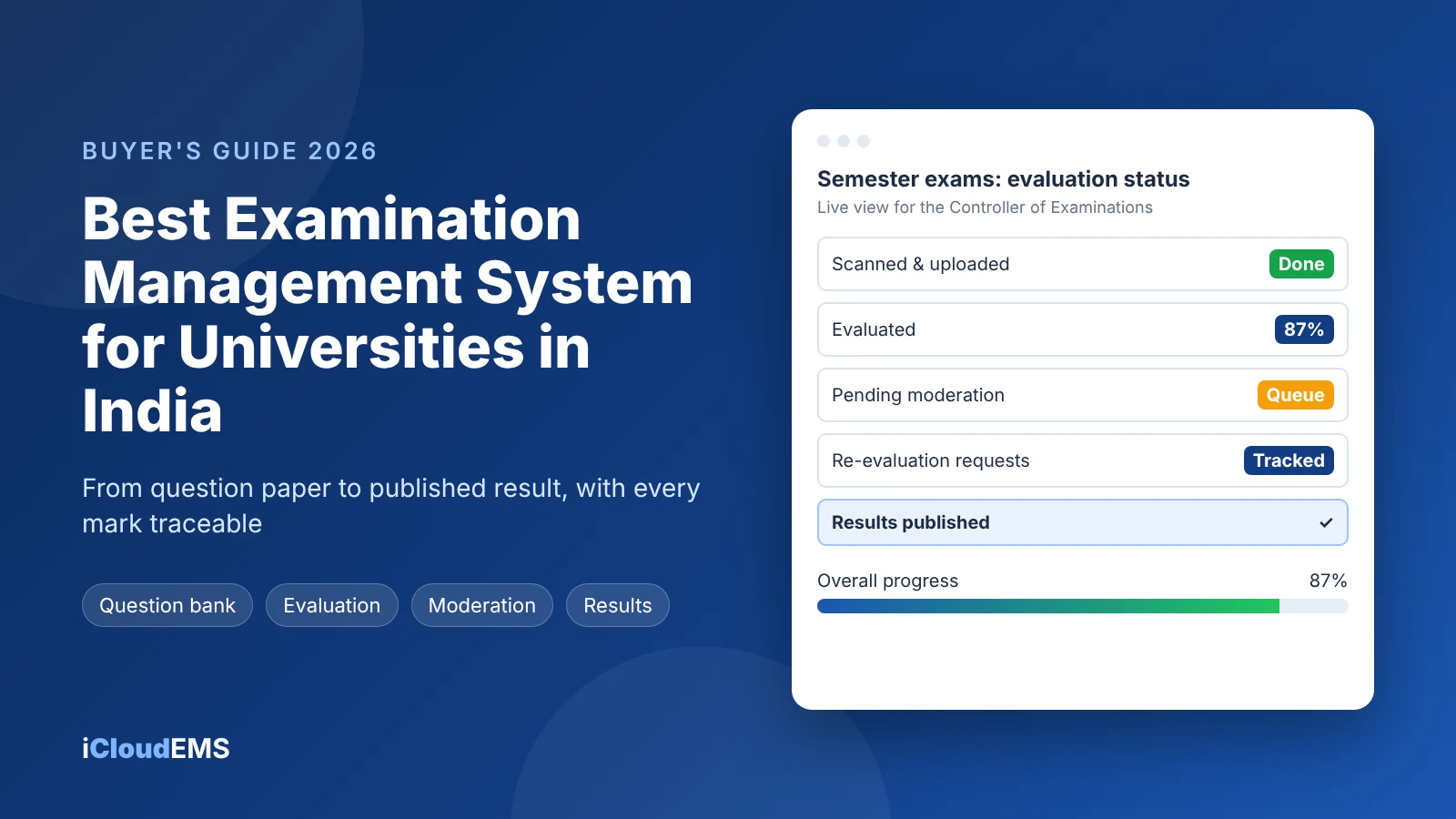
Next, look at where moderation and challenges happen. If moderation, re-totalling or challenge requests are handled outside the software, the audit trail breaks at exactly the point where you need it most. Then examine how marks move into results. Question-wise marks should compile automatically into results, because every manual re-entry adds a fresh chance of error. Finally, ask what the Controller of Examinations can see while evaluation is under way. A live dashboard showing scanned, evaluated, pending moderation and published scripts lets you fix a backlog in the first week instead of discovering it in the last.
What Sets iCloudEMS Apart When You Compare Exam Platforms
Most university management platforms in India can schedule exams, manage registrations and publish results, and many of them do it well. The real difference shows up in the part of the cycle that decides whether results arrive on time: evaluation. At iCloudEMS, the Digital Evaluation System (DES) is not an add-on attached to a wider platform. It is the core of how we approach examinations, and everything else connects to it.
Built around evaluation, not around a module list. The iCloudEMS Digital Evaluation System carries every answer sheet through six steps: scan, barcode, allocate, mark on screen, moderate and publish. Answer books never travel between examiners, barcode-based allocation keeps student identities masked, and examiners mark question by question while the system adds and records every mark, so nothing is re-typed. Moderation, re-evaluation and challenge workflows run inside the same system, and every action is written to a time-stamped audit trail.
Proven at full scale, not just in a pilot. Galgotias University evaluated 5,00,000 answer sheets on screen in a single cycle, completed evaluation in 10 days, spent 50% less time on evaluation and processed results in 7 days. The setup was sized for the cycle’s complete volume from the first day. You can read how it was done in the Galgotias University case study.
We fix the process, not just the software. In our experience, most of the delay in result season sits in the steps around marking: moving scripts, adding marks, entering data and chasing updates. Before configuring anything, our team studies where your exam cell loses time and shapes the workflow to remove those steps. Implementation, evaluator training and support during the live cycle all come from the iCloudEMS team, not a third party.
Evaluation data that keeps working after results. Because DES sits inside a platform of 52+ modules used by 150+ institutions across India and the UAE, exam data does not stop at the result sheet. AI question banks aligned with Bloom’s Taxonomy and mapped to CO-PO connect question papers to learning outcomes, and evaluation records feed NAAC, NBA and AISHE reporting. The Controller of Examinations follows live progress, from scanned to evaluated, pending moderation and published, on a dedicated role dashboard.
Security designed in from the start. After scanning, physical scripts stay in storage. Student identities are masked, access is controlled by role, and every allocation, mark and change is recorded, so the exam cell can explain any result mark by mark.
If you are comparing providers, ask each one to show these five things on screen during the demo. We are always glad to be measured against that list.
Questions to ask in every demo
Take these questions into every vendor presentation and ask each one to show the answer on screen rather than describe it.
- Which stages of our exam cycle does your system cover, and which will stay manual?
- Can you show an answer sheet moving from scanning to a published result?
- What exactly does an examiner see, and is the student’s identity hidden?
- Who can change a mark after submission, and how is that change recorded?
- How are re-evaluation and challenge requests handled and tracked?
- Do marks compile automatically, or does someone re-enter them?
- What does the live dashboard show the Controller of Examinations?
- How are question bank items mapped to Bloom’s levels and course outcomes?
- How does examination data reach our NAAC and NBA reports?
- Who handles migration of our past examination records?
If you are the Vice Chancellor or management
For leadership, examination management is ultimately about reputation and risk. A delayed result or a disputed mark can reach students, parents, regulators and the media within hours, and the damage often outlasts the problem itself. Start by asking how many people your result process depends on. If the honest answer is two or three individuals and a set of spreadsheets, that is a continuity risk that no amount of goodwill can remove.
Next, ask whether the exam cell can show the full trail behind any mark within a day, because that capability matters for re-evaluation, RTI requests and legal challenges alike. Finally, ask whether examination data will support accreditation without rework, since evaluation records should become accreditation evidence directly rather than being rebuilt each cycle. When you speak to vendors, ask for a phased plan that begins with one exam cycle or a defined set of programmes, with clear milestones and named owners on both sides.
If you are the IT head
As IT head, you will be responsible for keeping the system running at peak load during result season, when downtime is most visible and most costly. Begin with architecture and maintenance by asking whether the platform is cloud-native and what infrastructure your team will still need to manage. Confirm that role-based access allows examiners, moderators and exam cell staff to see only what their role requires, and nothing more.
Integration is the next priority. Examination data should connect cleanly to student records, results and accreditation modules, so ask the vendor to demonstrate those connections rather than describe them. Review scanning capacity carefully, including the scanners, bandwidth and staff the scanning stage needs at each campus. Then examine data protection, including who can view scanned answer sheets and marks and how access logs are kept, against your obligations under the Digital Personal Data Protection Act, 2023. This is not legal advice, so involve your legal team in that review. Finally, confirm who will migrate your legacy examination data and what support will be available during evaluation weeks.
Your next step
The clearest test of any examination management system is your own exam cycle, run on screen from scanned answer sheet to published result. Book a demo to see iCloudEMS handle evaluation, moderation and results, or contact our team to plan for your next semester.
Frequently asked questions
What is an examination management system?
An examination management system is software that helps a university run its exam cycle, from question papers and evaluation to moderation, re-evaluation and result publication, with a clear record of each step.
Which is the best examination management system for universities in India?
There is no single best system for every university. Map each option against your full exam cycle, give the most weight to evaluation and result processing, and check anonymity, the audit trail and automatic result compilation in a live demo.
Which part of the exam cycle should we digitise first?
Most delays and disputes happen during evaluation and result processing, so many universities start there. Digital evaluation removes the physical movement of answer books and manual totalling.
How does an examination management system help with re-evaluation?
When moderation, re-evaluation and challenge workflows run inside the same system as the original marking, the exam cell can show who marked each question, when, and what changed.
Can examination data be used for NAAC and NBA?
Yes. In iCloudEMS, evaluation data feeds accreditation evidence, and question banks are aligned with Bloom’s Taxonomy and mapped to CO-PO for outcome-based reporting.
How long does it take to move to a new examination management system?
It depends on exam volume and existing data. Ask vendors for a phased plan that starts with one exam cycle or a set of programmes, and confirm who handles data migration.
Sources
- Ministry of Education, All India Survey on Higher Education (AISHE) Final Report 2023-24: https://aishe.gov.in/
- National Assessment and Accreditation Council (NAAC), accredited institutions and NAAC Reforms 2024: https://naac.gov.in/index.php/en/
- National Board of Accreditation (NBA): https://www.nbaind.org/
- iCloudEMS, Digital Evaluation solution: https://icloudems.com/solutions/digital-evaluation/
- iCloudEMS, Accreditation & Compliance: https://icloudems.com/solutions/accreditation-compliance/
- iCloudEMS, Platform and products: https://icloudems.com/products/
- iCloudEMS, Galgotias University case study: https://icloudems.com/galgotias-university-digital-evaluation-case-study/
- Ministry of Electronics and Information Technology, Digital Personal Data Protection Act, 2023: https://www.meity.gov.in/static/uploads/2024/06/2bf1f0e9f04e6fb4f8fef35e82c42aa5.pdf