
How Galgotias University Evaluated 5 Lakh Answer Sheets in 10 Days with Digital Evaluation
How Galgotias University moved evaluation on screen with iCloudEMS, evaluated 5 lakh answer sheets in 10 days and processed results in 7 days, and what other universities can learn.
For a student, the days after the last exam are some of the longest. A result can decide a placement, a seat in a higher programme, or simply whether the next semester starts with confidence. Inside the exam cell, those same days look very different: bundles of answer books stacked by school and subject, examiners waiting for packets, totals being added by hand and re-typed into the system, and a result date that depends on the very last bundle coming back.
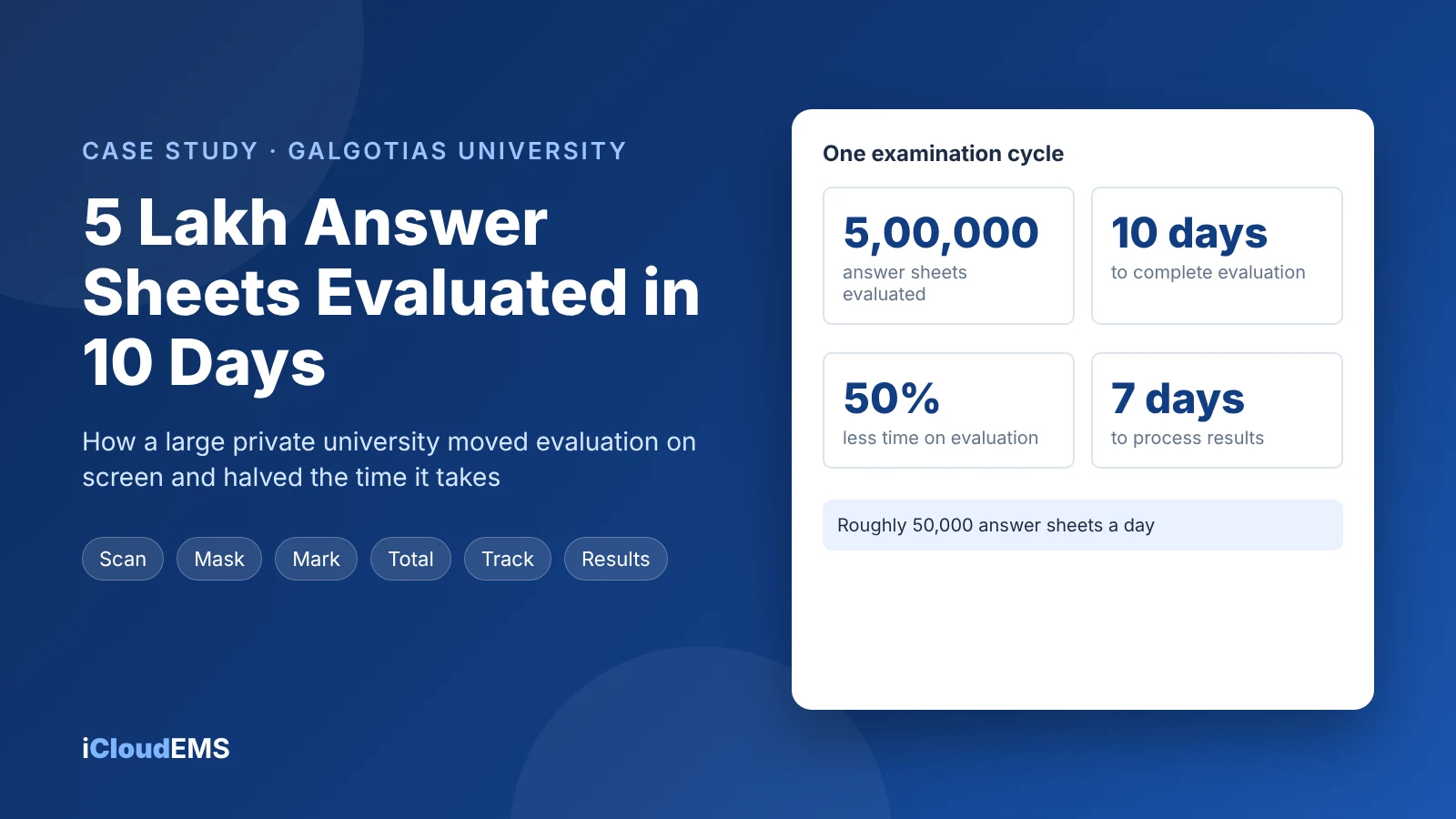
That was the reality at Galgotias University, a private university in Greater Noida, Uttar Pradesh, before it changed the way it evaluates examinations. Working with iCloudEMS, the university moved evaluation on screen and connected every step around it into one digital workflow. In a single examination cycle, it evaluated 5,00,000 answer sheets in 10 days, spent 50% less time on evaluation and processed results in 7 days. This digital evaluation case study explains what was slowing things down, what changed, and what other universities can learn from it. You can see the workflow behind these results on the iCloudEMS Digital Evaluation page.
The scale of the problem every large university faces
Galgotias is not unusual in the size of its examination load. According to the Ministry of Education’s All India Survey on Higher Education (AISHE) 2023-24, India has 1,289 universities and university-level institutions, 546 of them private (un-aided), and total enrolment of nearly 4.5 crore students. Every one of those students writes several papers each semester, which means large universities handle lakhs of answer sheets per cycle, often across many schools and programmes.
With a large student body and examinations running across schools, each cycle at Galgotias produced lakhs of answer sheets that had to be evaluated accurately and declared on time. The people involved worked hard. The difficulty was that the process had too many handoffs, and each one added a little delay.
Where things slowed down
When the university looked closely at its evaluation cycle, the challenge was never a lack of effort. It was the amount of manual work sitting between a marked answer and a declared result. Four problems stood out.
The first was moving paper. Answer sheets were bundled, carried, tracked and stored at every stage, and each movement took time and created a risk of delay. The second was adding marks by hand. Totals were added manually, typed into the system and then re-checked to catch mistakes, which meant every mark was handled several times before a student ever saw it. The third was waiting on the last bundle. Results could not move until every sheet was back, so a single delayed batch held up everyone else. The fourth was limited visibility. At any given moment, it was hard to see how much evaluation was done and how much was left.
Looking back, most of the delay sat in moving paper and re-handling numbers. Marking itself was only one part of it. That insight shaped everything that followed, and it is the most important lesson in this story for any university planning on-screen evaluation at scale.
What iCloudEMS put in place at Galgotias
iCloudEMS set up one digital workflow that takes an answer sheet from the scanner to the result. Once a sheet is scanned, everything that follows happens on screen. Answer sheets are scanned and uploaded securely, and copies are assigned to evaluators automatically with the student’s identity masked. Faculty then read and mark each answer on screen, question by question. The system adds the marks and records them, so nothing is re-typed. Throughout the cycle, the exam cell can see progress as it happens, and once evaluation closes, marks move directly into result processing with a complete record available for any revaluation request.
How the work was approached mattered as much as the software. The setup was sized for the full cycle from the beginning, built to carry the complete volume rather than a small pilot. The team followed a “process before software” principle, first identifying where time was being lost and then shaping the workflow to remove those steps. Implementation, evaluator training and support during the live cycle came from the iCloudEMS team. And security was built in from day one, with masked identities, controlled access and a full record of every action.
Behind the evaluation workflow sits the wider iCloudEMS platform, which brought its own milestone: 11 years of the university’s data were migrated as part of the implementation.
The results: half the time, at full scale
The headline numbers speak for themselves: 5,00,000 answer sheets evaluated, 10 days to complete evaluation, 50% less time spent on evaluation and 7 days to process results. That works out to roughly 50,000 answer sheets a day. The table below shows what changed underneath those numbers.
| Area | Before iCloudEMS | With iCloudEMS |
|---|---|---|
| Answer sheets | Bundled, carried, tracked and stored by hand | Scanned once, then handled only on screen |
| Totalling | Added manually, typed in and re-checked | Added and recorded by the system |
| Progress | Clear only once every bundle was back | Visible to the exam cell throughout |
| Time spent on evaluation | Full manual effort | Reduced by 50% |
| End-to-end running time | Full manual process | Reduced by 50% |
| Result processing | Dependent on manual totals and data entry | 7 days |
| Records | Spread across paper files and registers | One digital audit trail |
With evaluation on screen, results no longer wait for paper to return. Once evaluation closes, Galgotias processes results in 7 days and declares them on schedule, with audit-ready records from the very first sheet.
What changed for each group
For the exam cell, result season stopped being a race against paper. The work became something the team could see, plan and manage, instead of something that only became clear once every bundle had returned. For faculty, effort went into reading answers rather than handling bundles and re-adding totals, which is where an examiner’s expertise belongs. For students and parents, results arrived when they were expected, with a clear record behind every mark.
The benefits also reached beyond the exam cell. Predictable results meant students and parents could plan placements, admissions and next steps with confidence. Because every allocation, mark and change is recorded as it happens, the university is better prepared for accreditation reviews, with evidence already in one place. And timely, transparent results strengthen trust among current students and parents, and shape how future applicants see the university.
Myths about digital evaluation, and what Galgotias found
Many universities still hesitate to move evaluation on screen because of a few common beliefs. The Galgotias experience answers each of them directly.
The first belief is that digital evaluation suits small exams, not a large university. Galgotias evaluated 5 lakh answer sheets on screen in a single cycle. The second is that it is the same work, just on a computer. In practice, removing the manual steps around marking is what halved the running time. The third is that paper is safer. After scanning, scripts stayed in storage, identities were masked, access was controlled and every action was recorded. The fourth is that faster means less careful. Faculty still read and marked every answer; what went away was the waiting, carrying and re-adding. The fifth is that accreditation paperwork is a separate, last-minute job. Because every evaluation step is logged as it happens, the records exist from day one.
In their words
Galgotias leadership has spoken publicly about the decision. Mr. Dhruv Galgotia, Chief Executive Officer of Galgotias University and Group, said: “After evaluating more than 10–15 digital platform vendors across India, I am certain that iCloudEMS is the number one service provider in all aspects in the space of higher education. The NAAC and OBE module is by far the best in the industry. Galgotias University implemented the platform in record time with accuracy of 11 years of sensitive, voluminous data.”
Questions to ask in every demo
If the Galgotias story has prompted you to consider digital evaluation, these questions will help you test any provider against what worked there.
- Can your setup carry our full examination volume from the first cycle, not just a pilot?
- Where do you see time being lost in our current process, before we discuss features?
- How are student identities masked during allocation and marking?
- Does the system add and record marks, so nothing is re-typed?
- What can the exam cell see about evaluation progress during the cycle?
- How do marks move into result processing, and what record exists for revaluation?
- Who provides evaluator training and support during the live cycle?
- How is access controlled, and is every action recorded?
- How will evaluation records support our accreditation reviews?
- Can we speak to a university of similar size that runs evaluation this way today?
If you are the Vice Chancellor or management
The lesson from Galgotias for leadership is that faster results are not mainly about pushing evaluators harder. In iCloudEMS’s experience, the bigger gains sit in the steps around evaluation: moving scripts, adding marks, entering data and chasing updates. Take those steps out, and the same faculty can finish the same work in far less time. Ask your team how much of your current result timeline is spent on marking, and how much is spent waiting for paper and re-handling numbers. The answer usually makes the case for change on its own.
It is also worth considering what predictable results mean for the institution as a whole. On-time declaration affects placements, progression and admissions for the next cycle, and transparent records strengthen the university’s reputation with students and parents. When you evaluate providers, ask for a plan sized for your full volume, with clear milestones and named owners.
If you are the IT head
For the IT head, the Galgotias implementation highlights a few practical priorities. The setup must be sized for peak volume, because evaluation season leaves no room for performance problems. Security should be designed in, not added later: masked identities, controlled access and a full record of every action should all be standard. Ask how scanned scripts are stored, who can view them and how access is logged, and review this against your obligations under the Digital Personal Data Protection Act, 2023. This is not legal advice, so involve your legal team in that review.
Data migration deserves careful attention too. At Galgotias, 11 years of data were migrated as part of the implementation, which shows how much historical information a university depends on. Confirm who will migrate your records, how they will be validated, and what support will be available during the live cycle.
Your next step
Galgotias University has shown that digital evaluation works at a scale of 5 lakh answer sheets in one cycle. For institutions expecting more students and tighter result timelines, it is now a practical, proven way to run examinations. Book a demo to see how iCloudEMS Digital Evaluation could work for your university, or talk to our team about your next examination cycle.
Frequently asked questions
How many answer sheets did Galgotias University evaluate with iCloudEMS?
Galgotias University evaluated 5,00,000 answer sheets on screen in a single examination cycle, completing evaluation in 10 days.
How much time did digital evaluation save at Galgotias University?
Time spent on evaluation was reduced by 50%, end-to-end running time was halved, and results were processed in 7 days after evaluation closed.
What slowed down evaluation before the change?
Most of the delay came from moving paper and re-handling numbers: bundling and carrying answer sheets, adding totals by hand, waiting for the last bundle and limited visibility of progress.
Is digital evaluation secure for a large university?
At Galgotias, scripts stayed in storage after scanning, student identities were masked, access was controlled and every action was recorded.
Did faculty still mark every answer?
Yes. Faculty read and marked every answer on screen, question by question. The system added the marks, so the waiting, carrying and re-adding were removed.
Does digital evaluation help with accreditation?
Yes. Every allocation, mark and change is recorded as it happens, so evaluation records are ready when an accreditation review or audit comes up.
Sources
- iCloudEMS, Client Success Story: How Galgotias University evaluated 5 lakh answer sheets in 10 days (October 2026)
- iCloudEMS, Digital Evaluation solution: https://icloudems.com/solutions/digital-evaluation/
- Ministry of Education, All India Survey on Higher Education (AISHE) Final Report 2023-24: https://aishe.gov.in/
- Ministry of Electronics and Information Technology, Digital Personal Data Protection Act, 2023: https://www.meity.gov.in/static/uploads/2024/06/2bf1f0e9f04e6fb4f8fef35e82c42aa5.pdf